Tsundoku: Why You Buy Books Faster Than You Read Them
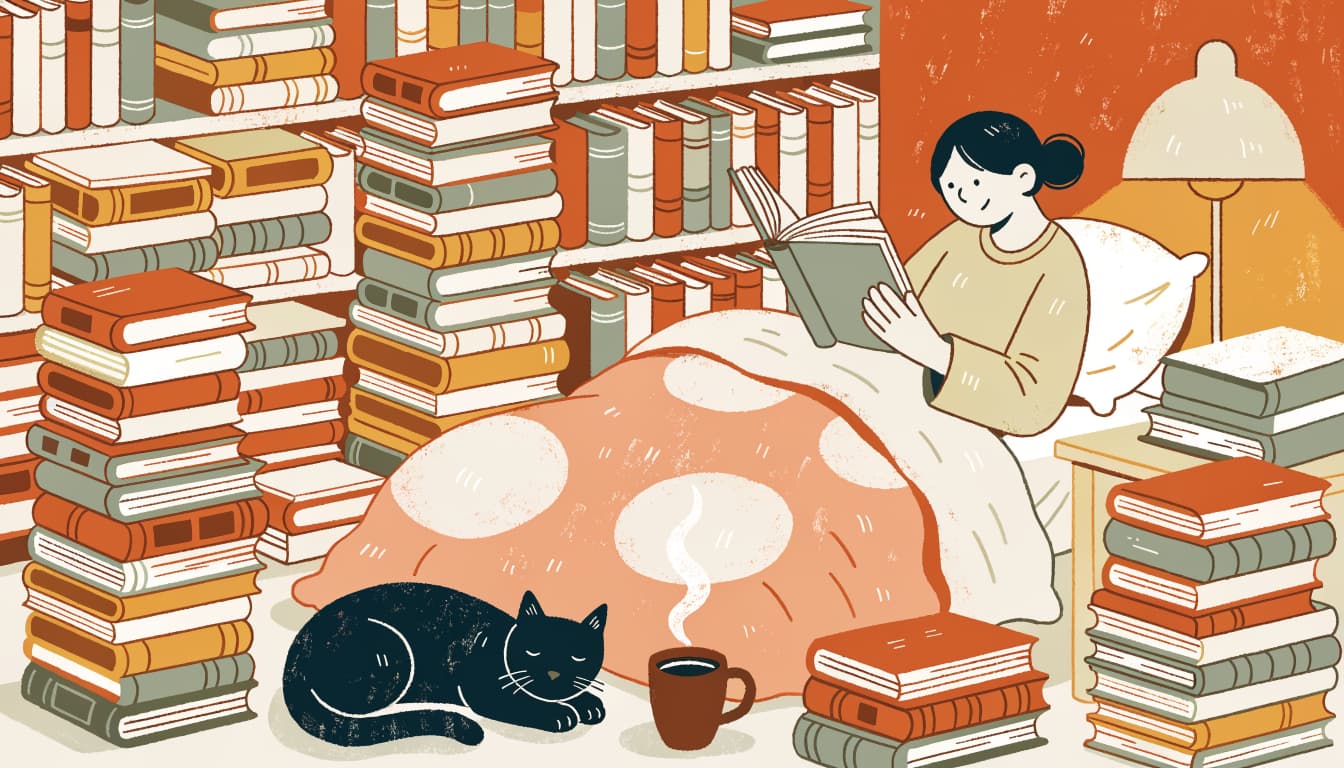
There is a stack of books on my nightstand that I have moved, twice, while cleaning, without reading a single one of them. There's another stack on the floor by the window. A shelf and a half are books I bought with real intention and have not yet opened. I used to feel a low hum of guilt about this. Then I learned there's a word for it, and the word turned the guilt into something closer to affection.
The word is tsundoku, and if you buy books faster than you can possibly read them, you practice it too. Here's where it comes from, why we can't seem to stop, and why your unread pile is not the problem you think it is.
What tsundoku means
Tsundoku is a Japanese word for buying books and letting them pile up unread — and, by extension, for the pile itself. It dates to Japan's Meiji era, when reading was booming, and first appeared in print around 1879. It's a small piece of wordplay: it blends tsunde-oku, "to pile things up and leave them," with dokusho, "reading books." Pile them up, mean to read them, don't quite get there. Buy a book, shelve it next to the last three you bought, repeat.
What I love about the word is how gentle it is. It isn't hoarding and it isn't waste. It names a specific, tender human habit — acquiring books in good faith, faster than any mortal could read them — and it does so without a scolding.
Why we can't stop
The mechanics of tsundoku are almost unfair. Buying a book takes a minute. Reading one takes days. You're usually still in the middle of something when the new arrival lands on the pile, so of course the stack grows faster than you can shrink it. The math was never going to work.
But there's more than logistics at play. There's a real little hit of pleasure in acquisition itself — the cover, the heft, the promise of the thing. Buying a book is buying a small, hopeful version of your future self: the one who will read this, who will have time, who will be the sort of person who's read it. The purchase is partly an act of optimism. That's why it feels good, and that's why "just stop buying books" is advice almost no reader has ever taken.
Why your unread pile is actually fine
Here is the reframe that let me stop apologizing for my shelves.
A pile of unread books is not a stack of failures. It's a stack of intentions — a physical map of everything you're curious about. The writer Umberto Eco kept a famously enormous library, most of it unread, and the idea that grew up around it has a name: the antilibrary. The point of the unread books isn't that you've failed to read them. It's that they surround you with how much there is still to know. A shelf of books you've already finished is a record of where you've been. A shelf of unread ones is a standing invitation to keep going.
Looked at that way, tsundoku is a sign of appetite, not negligence. You keep buying books because you keep being interested in things, which is, on balance, a wonderful way to move through the world. The unread pile is hope in physical form.
When it tips over
All of which is permission, not a free pass. There's a point where a happy antilibrary becomes a source of low-grade dread — when the pile is so big you can't see what's in it, when you keep re-buying books you already own because you forgot, when walking past the shelf makes you feel behind instead of curious. That's not tsundoku's fault; that's just lost track.
The fix isn't to stop buying books. (Let's be serious.) It's to be able to see your pile clearly enough that it stays a pleasure instead of a reproach.
How to make peace with the pile
A few gentle, non-puritanical ways to enjoy your tsundoku without drowning in it:
Get the whole pile in one place you can actually see. The dread comes from vagueness — from a pile that's really five piles in four rooms plus a vague sense of "some on the e-reader." When you can see everything you own-but-haven't-read in a single list, it stops being an amorphous guilt-cloud and becomes what it always was: a really good personal bookshop, curated entirely by past versions of you who knew your taste.
Shop your own shelves first. Before buying something new, browse what you already have the way you'd browse a store. The next great read is very often already on the pile.
Buy intentionally, not just impulsively. You don't have to quit the dopamine — just aim it. Buying a book because you genuinely want to read it soon is different from buying it because it was 30% off and you were sad.
Let yourself not finish. Part of what clogs a pile is the sense that every book is a debt you owe. It isn't. Reading is allowed to be for pleasure, and a book you abandon at page 40 has still given you what it was going to give you.
This is the unglamorous reason I keep my own pile on a LitShelf Want to Read shelf. Every book I mean to get to — the nightstand stack, the floor stack, the ones I'd otherwise forget I owned — lives in one place I can scroll through and actually shop. I stop double-buying. I can see, honestly, how big the pile is (humbling, but useful), and I can pull from it on purpose instead of standing in a shop buying a fourth copy of intention. The pile didn't shrink because I shamed it. It got better because I could finally see it.
Pile on
So buy the book. Add it to the stack. The unread pile isn't evidence that you're failing at reading — it's evidence that you're still curious, still hopeful, still reaching for the next thing. That's the good part.
Just keep the pile somewhere you can see it, so it stays a promise instead of a pang. Then go read whichever one of them you're actually in the mood for tonight.
Want your whole unread pile in one place you can finally see? That's what we built LitShelf for.
More from the blog
Reading Journal Ideas: What to Track (Paper or Digital)
Reading journal ideas: what to actually track, the honest case for paper vs. digital, and how to keep a reading journal you won't abandon by March
Reading Challenge Ideas: 12 Ways to Read More
Reading challenge ideas that add variety, not pressure — 12 formats (prompts, themes, genre-stretch, backlist) and how to pick one you'll actually finish.